MobileNet
What MobileNet Does
MobileNet is a family of compact convolutional networks designed for phones, embedded systems, and other latency- or power-constrained devices. It can serve as a classifier or as the backbone of detection and segmentation models.
MobileNetV1 was introduced in MobileNets: Efficient Convolutional Neural Networks for Mobile Vision Applications. V2 added inverted residuals and linear bottlenecks; V3 combined hardware-aware architecture search, squeeze-and-excitation, and hard-swish.
Core Idea
A standard convolution learns spatial patterns and mixes channels in one expensive operation. MobileNetV1 factors it into a depthwise convolution that filters each channel separately and a pointwise convolution that mixes channels.
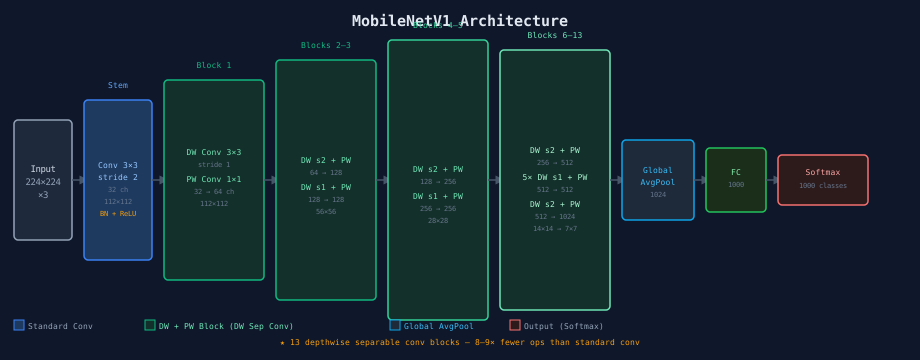
MobileNetV1 Architecture
Source: Howard et al., 2017 — MobileNets: Efficient CNNs for Mobile Vision (Google)
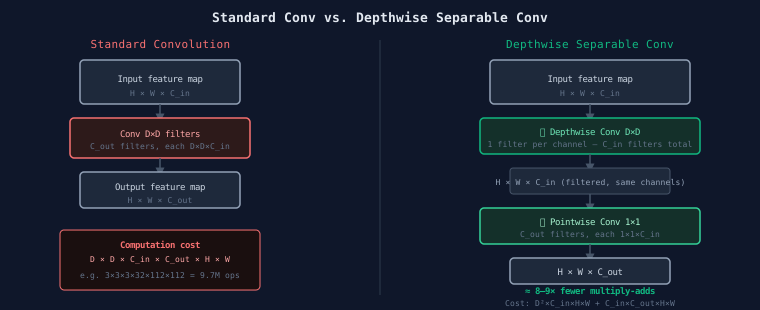
Depthwise Separable Convolution
Source: Howard et al., 2017 — MobileNets: Efficient CNNs for Mobile Vision (Google)
How It Works
1. Separate Spatial and Channel Processing
For a kernel, input channels, output channels, and an feature map:
- Standard convolution:
- Depthwise convolution:
- Pointwise convolution:
The separable-to-standard cost ratio is . With a kernel and many output channels, this approaches a ninefold arithmetic reduction, though measured latency depends on hardware and kernels.
2. Choose an Accuracy–Cost Point
V1's width multiplier scales channel counts; its resolution multiplier scales spatial dimensions. Compute therefore changes approximately with , subject to channel rounding and fixed layers.
3. Preserve Information in MobileNetV2
An inverted residual block expands a narrow input, applies a depthwise convolution in the wide space, then linearly projects back to a narrow output. A residual connection is used when shape and stride permit. Keeping the projection linear avoids destroying information in the low-dimensional bottleneck.
4. Optimize for Real Devices in MobileNetV3
MobileNetV3 uses platform-aware neural architecture search, squeeze-and-excitation for channel recalibration, and hard-swish:
h-swish(x) = x · ReLU6(x + 3) / 6
Representative ImageNet configurations range from MobileNetV3-Small (about 2.5M parameters) to MobileNetV3-Large (about 5.4M); exact accuracy and latency depend on training recipe and device.
Why It Works
- Spatial filtering does not always need to be repeated independently for every output channel.
- Cheap convolutions handle most channel interaction.
- Width and resolution controls let deployment teams target a measured resource budget.
- V2 and V3 place capacity where it offers useful accuracy without restoring the full cost of standard convolutions.
Limitations
- Fewer operations do not guarantee lower latency: depthwise kernels can be memory-bound or poorly optimized.
- Small variants trade away capacity and may struggle on fine-grained classes or dense prediction.
- Width, resolution, quantization, and runtime must be benchmarked on the target device.
- Training small models from scratch can be sensitive; pretrained initialization and distillation are often helpful.
Evolution
- EfficientNet (2019) — compound scaling with MBConv-style blocks
- MobileViT (2021) — local convolutions combined with transformer processing
- NASNet / MnasNet — architecture-search families
- ShuffleNet — grouped convolutions and channel shuffle
Related
Sources
- MobileNets: Efficient Convolutional Neural Networks for Mobile Vision Applications — MobileNetV1 by Howard et al. (2017)
- MobileNetV2: Inverted Residuals and Linear Bottlenecks — Sandler et al. (CVPR 2018)
- Searching for MobileNetV3 — Howard et al. (ICCV 2019)
- MobileNet — Wikipedia
- PyTorch MobileNet pretrained models
- TensorFlow Lite MobileNet guide